By Seattle Dave • Updated: February 9, 2026
My Favorite Hotels in Las Vegas
• 5-Star: Wynn • Venetian
• 4-Star: Mandalay Bay • Caesars Palace
• 3-Star: The LINQ
• For Families: Mandalay Bay
• For Couples: Waldorf Astoria
• Non-Gaming: Vdara • Four Seasons
• Boutique: The Cromwell • Crockfords
• Hotel Pool: Mandalay Bay
• Near Sphere: Venetian • Palazzo
• Central Location: Bellagio
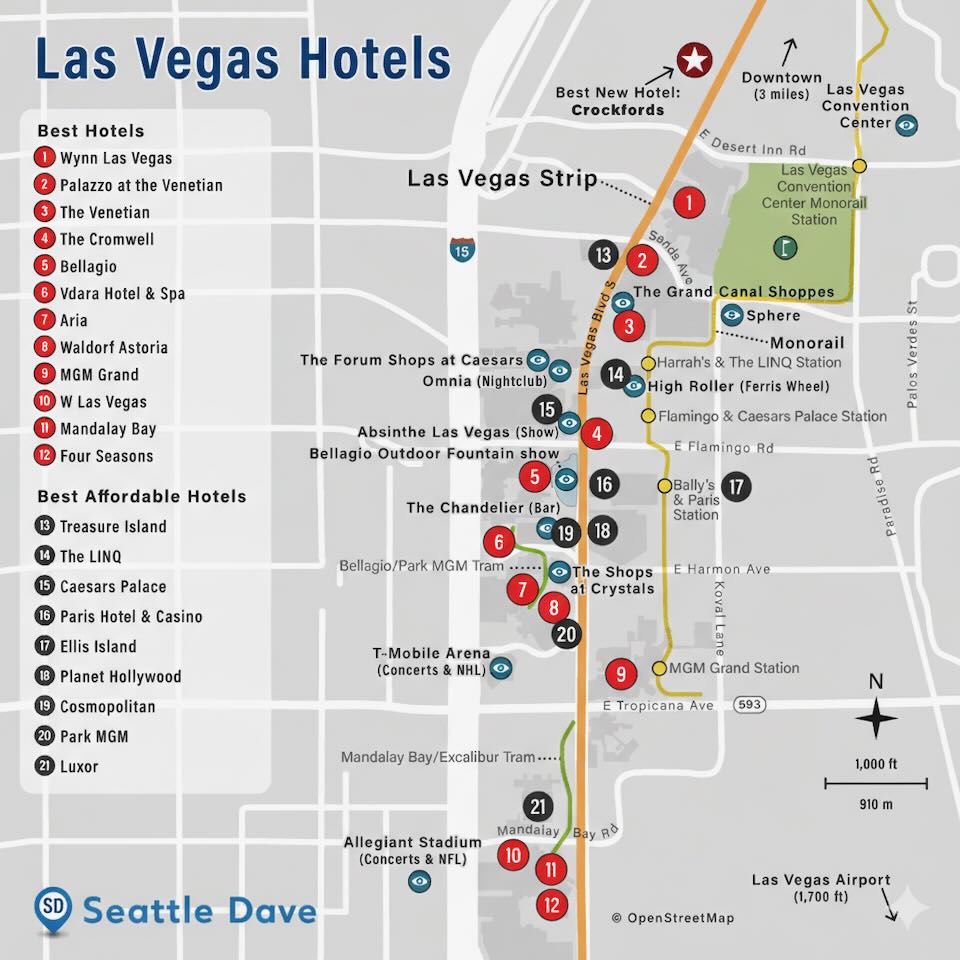
Best Hotels: 1. Wynn Las Vegas • 2. Palazzo at the Venetian • 3. The Venetian • 4. The Cromwell • 5. Bellagio • 6. Vdara Hotel & Spa • 7. Aria • 8. Waldorf Astoria • 9. MGM Grand • 10. W Las Vegas • 11. Mandalay Bay • 12. Four Seasons
Best New Hotel: Crockfords
Affordable Hotels: 13. Treasure Island • 14. The LINQ • 15. Caesars Palace • 16. Paris Hotel & Casino • 17. Ellis Island • 18. Planet Hollywood • 19. Cosmopolitan • 20. Park MGM • 21. Luxor
Best Areas to Stay in Las Vegas
The first and most important choice for any visitor to Las Vegas is simple: Stay on the Strip. It is the center of the action, the most efficient place to see the city’s highlights, and the best use of your limited time. Only experienced regulars should consider sacrificing that convenience for a cheaper hotel miles away in the suburbs.
The Las Vegas Strip is a roughly four-mile stretch of Las Vegas Boulevard, running from the iconic “Welcome to Fabulous Las Vegas” sign (near Mandalay Bay and Allegiant Stadium) north to Fontainebleau and The STRAT at Sahara Avenue. This stretch defines the modern image of Las Vegas.
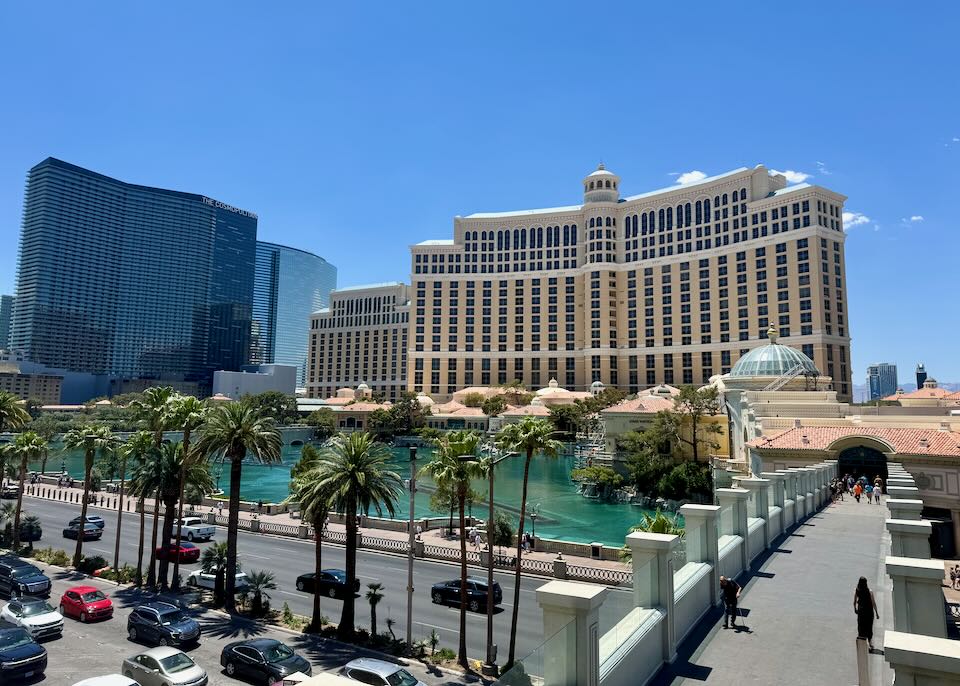
If I had to pick one hotel with the most central location on the Las Vegas Strip, it would be the Bellagio.
8 Things to Know Before Booking
- 1. The “Resort Fee” Strategy (And How to Beat It)
Everyone hates resort fees ($40–$55/night), but insiders know how to soften the blow. The Hack: Sign up for MGM Rewards or Caesars Rewards. Mid-tier status (often easily gained via a status match from Hyatt, Wyndham, or Hilton) can waive resort fees at many properties. If you don’t have status, check Treasure Island (TI), which often has optional or reduced fees.- 2. The “Door-to-Street” Walking Reality
“Distances are deceptive” is an understatement. The biggest rookie mistake is trusting Google Maps walking times. It doesn’t account for the “casino maze.” At massive resorts like MGM Grand, Venetian, or Caesars Palace, it can take 15–20 minutes just to walk from your hotel room to the sidewalk. Remember: Vegas hotels are not designed for efficiency – they’re designed to keep you inside. Shoe Rule: Vegas is a walking city disguised as a taxi city – wear shoes you’d be comfortable walking 5–7 miles in.- 3. Pricing is Event-Driven, Not Just “Weekend-Driven”
Don’t assume a Tuesday in November is cheap. Vegas pricing is dictated by conventions and events, not the calendar. Massive conferences like CES, SEMA, or AWS re:Invent can make a random Tuesday more expensive than a holiday weekend. Similarly, F1, boxing matches, and residency openers cause citywide price explosions. Always check the Las Vegas Convention Calendar before locking in dates.- 4. Refine Your Definition of “Center Strip”
Real “Center Strip” is a tight cluster: Bellagio, Caesars Palace, Cosmopolitan, and Paris. Hotels adjacent to this core often feel much closer to the action than those technically just a mile down the road. Hotels like Planet Hollywood or Horseshoe can still work if the price is right, but once you go farther out, convenience drops fast. If you stay too far north (The STRAT) or south (Luxor), you aren’t “saving money” – you are just paying the difference in Uber fares and lost time.- 5. Tower Choice & Vibe Matters More Than Star Rating
Booking the hotel is only half the battle; you need to book the right tower. At Caesars Palace, the Augustus Tower is luxury, while the Forum Tower is tired. At MGM Grand, the West Wing is a glorified closet compared to the Main Tower. The Vibe Check: Casino smoke and noise vary wildly. Park MGM is fully smoke-free, while the Cosmopolitan has a loud party energy that bleeds into the rooms. Warning: “Strip View” rooms often face nightclubs, meaning bass-thumping noise until 4 am.- 6. Not All Pools Are Created Equal
A pool is a strategy decision, not a checkbox. Mandalay Bay has the best massive pool complex (wave pool + lazy river), while Venetian/Palazzo offers a more refined, quieter deck. Note that “Dayclubs” often take over the best pools on weekends – guests may lose access or be forced to pay cover. Winter Reality: Heated pools don’t stop the desert wind. If you visit Nov–Feb, the wind chill matters more than the water temp.- 7. When a Rental Car Actually Makes Sense
For a standard Strip trip, a car is a liability (parking fees + gridlock). However, a car is worth it if you are splitting your stay between the Strip and Downtown/Fremont Street, or staying at off-Strip resorts like Red Rock or Green Valley Ranch. It can also save you money during peak times – Uber/Lyft surge pricing after a major show (like Adele or U2) can sometimes cost more than a full day of rental car parking.- 8. The Check-In & Room Assignment Game
Vegas hotels operate differently than standard hotels: they aggressively monetize early access ($30–$75) and often assign the worst rooms (low floor, view of a brick wall) to the first people who show up. The Fix: Use mobile check-in to often bypass fees, or conversely, check in late (after 7 pm) when inventory is sorted.
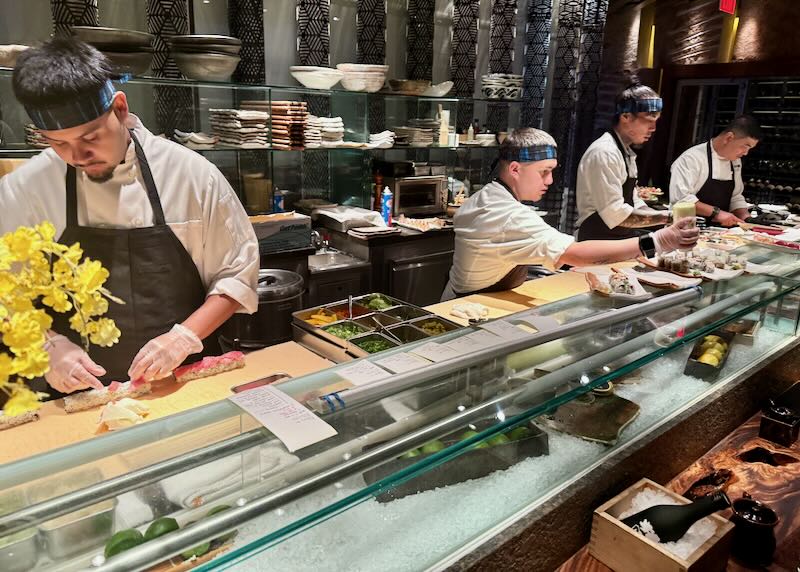
Pro Tip: Speak to a human if you care about your room. Asking politely at the desk (“Do you have anything on a higher floor or away from the elevators?”) works better in Vegas than almost anywhere else – front desk agents have immense discretion here.Sushi chefs preparing fresh rolls and orders at The Cosmopolitan.
What Defines the Strip:
- Spectacle and Scale: Every major property (Caesars Palace, Bellagio, Wynn, Venetian, etc.) is a self-contained destination. They compete to offer the most over-the-top experience, driving the city’s identity.
- The New Economy: While casinos remain, the primary economic drivers now are celebrity chef restaurants, massive nightclubs, high-end shopping (like Crystals at Aria or The Forum Shops at Caesars), world-class residencies, and a massive sports economy. With Allegiant Stadium, T-Mobile Arena, and the Sphere, Las Vegas is now a global sports and high-tech entertainment capital.
- Variety of Hotels: The Strip offers a hotel for every traveler. You have identity-driven resorts like Excalibur and Luxor, balanced by ultra-modern, high-design luxury properties like Aria, The Cosmopolitan, and Fontainebleau. This broad appeal means the best hotels for families can also be ideal for couples or business travelers.
- Walkability and Energy: The action is no longer confined indoors. Outdoor public spaces like The LINQ Promenade and The Park (near T-Mobile Arena) have cultivated a new open-air energy, making the Strip vibrant both day and night. Just remember: Vegas scale is deceptive – distances that look short on a map often require pedestrian bridges and significant walking.
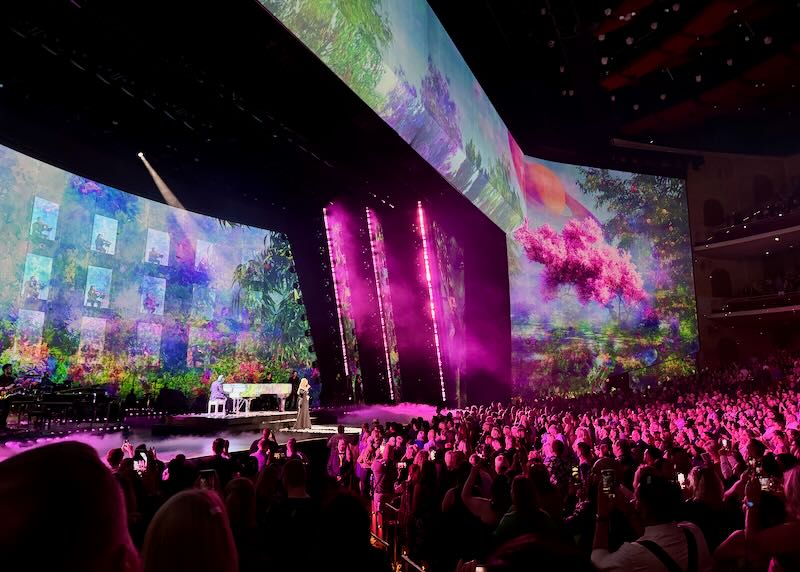
We saw Adele in concert at Caesars Palace.
Beyond the Strip:
The Strip is the primary hub for exploring the rest of Southern Nevada, but the surrounding areas offer a completely different side of the valley.
- Downtown and Fremont Street: Continue north on Las Vegas Boulevard to reach the original Downtown district. This area is famous for its historic casinos, lower gambling limits, and the Fremont Street Experience– a massive LED canopy show that covers a five-block pedestrian mall. Beyond the lights of Fremont, the Arts District has become a local favorite for craft breweries, vintage shops, and independent galleries.
- Suburbs and Sports: While Henderson and Summerlin are primarily residential, they offer high-end “locals” resorts like Red Rock and Green Valley Ranch for those who want to avoid the Strip crowds. Las Vegas is now a major sports destination; while most action is near the Strip at Allegiant Stadium (Raiders) and T-Mobile Arena (Golden Knights), the baseball stadium in Summerlin is excellent for a more relaxed afternoon game.
- Excursions: Staying on the Strip makes it easy to arrange tours to Hoover Dam, Valley of Fire State Park, and the Grand Canyon. If you are heading to the Canyon, helicopter tours are a significant, but worthwhile, upgrade over the long bus ride.
For your first visit, or even your fifth, staying on the Strip is the best way to experience the lights and energy that Las Vegas is famous for.
Best Places to Stay in Las Vegas
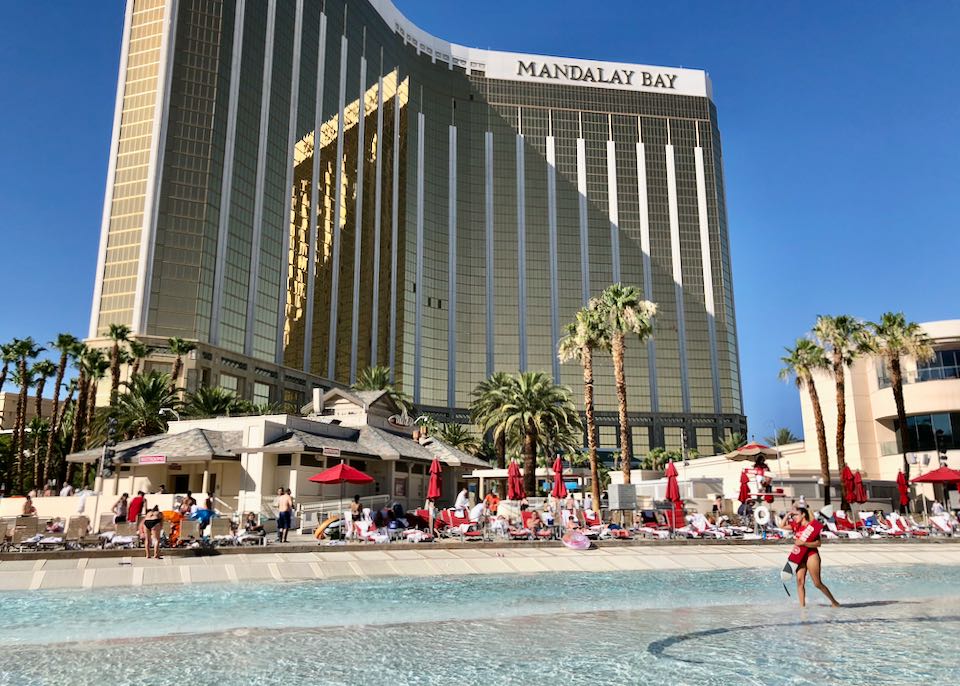
My favorite hotel pool and lazy river in Las Vegas is shared between the Mandalay Bay, W Las Vegas, and Four Seasons.
- Best 5-Star Luxury Resorts on the Strip
Wynn Las Vegas • Aria • Bellagio • The Venetian- Best Boutique & Luxury Enclaves on the Strip
Waldorf Astoria • Four Seasons • The Cromwell • The Reserve • Crockfords • Vdara- Best 4-Star Hotels on the Strip
Mandalay Bay • Palazzo at the Venetian • W Las Vegas • MGM Grand • Caesars Palace • Sahara- Best 3-Star Hotels on the Strip
LINQ Hotel & Casino • Treasure Island • The STRAT • Circus Circus- Best Hotels Downtown & Off-Strip
Downtown Grand • Golden Nugget • Four Queens • Hampton Inn Tropicana • Ellis Island- Best Hotel Pools in Las Vegas
Mandalay Bay • Caesars Palace • MGM Grand • Four Seasons- Best Las Vegas Hotels for Families
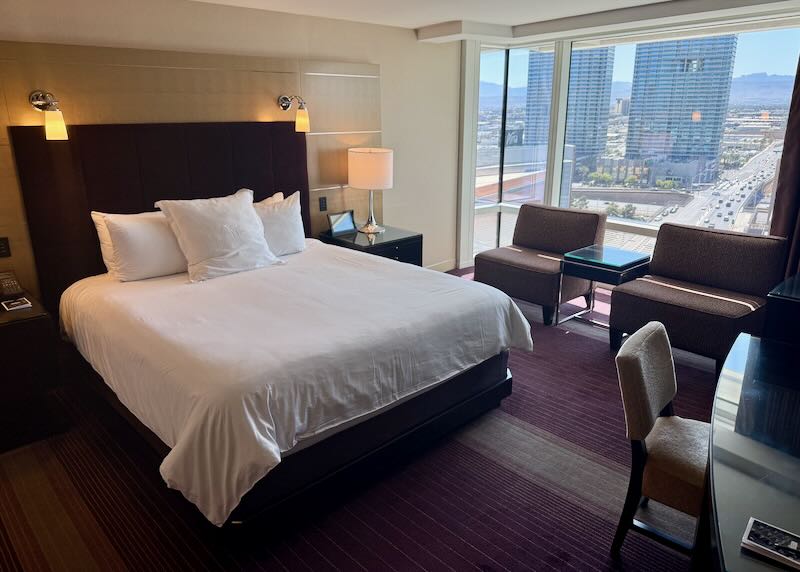
Mandalay Bay • Four Seasons • The Golden Nugget • Circus CircusOur suite at the Four Seasons.
Our suite at the Venetian.
Our room at the Bellagio.
Our room at the Aria.
Best Las Vegas Neighborhoods
Best Area for First-Time Visitors (Center Strip)
For most first-time visitors, there is only one correct answer: Center Strip. This specific cluster – roughly stretching from Bellagio and Caesars Palace south to Paris and Planet Hollywood – is the only part of Las Vegas where you can step out of your hotel lobby and be immediately surrounded by a walkable cluster of major sights. Imagine walking from the Bellagio Fountains to the Caesars statues to the Cosmopolitan’s chandelier bar without ever needing a taxi. While hotels here command a price premium, the extra cost is offset by what you save on Uber fares and lost time. Rookie Mistake: Do not assume every hotel with a “Las Vegas Blvd” address is convenient. Staying at the far north end (The STRAT) or far south end (Luxor/Mandalay Bay) creates dependency on rideshares and long internal walks just to reach the sidewalk. If this is your first Vegas trip, location matters more than hotel brand – Center Strip wins.
Best Area for Classic Vegas Sights
The Strip is a living timeline of pop culture, mixing old-school glam with futuristic tech. For the highest density of icons, Center Strip remains the undefeated base. From here, you can walk to the true classics: the famous Fountains at Bellagio and the Eiffel Tower replica at Paris. To see the modern marvels and outliers, you will need to travel. The massive LED Sphere is conveniently accessed via the indoor bridge at The Venetian, while the High Roller wheel anchors the LINQ promenade. Farther out, you have the “Welcome to Las Vegas” sign (near Mandalay Bay) and the observation deck at The STRAT to the north. Save your feet by using the Monorail or free trams to reach these edges. Pro Tip: The best views aren’t always from the sidewalk; book a “Fountain View” room or visit a high-elevation lounge like Skyfall to see the neon sprawl from above. If sightseeing is your priority, stay central and use transit for the rest.
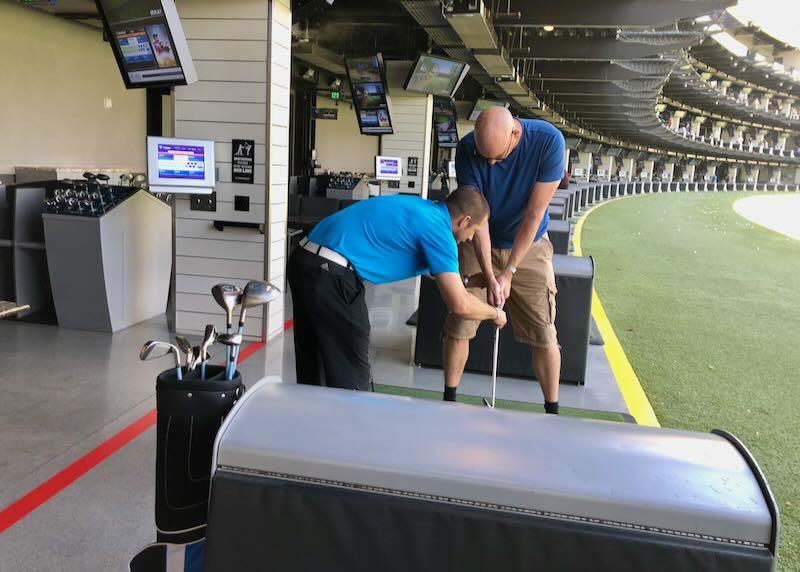
Me getting a few tips at Las Vegas Topgolf. Good fun.
Best Area for Gambling (Downtown/Fremont)
If you prefer lower table minimums to fancy decor, Downtown (specifically Fremont Street and surrounding blocks) is superior to the Strip. You are far more likely to find player-friendly rules here, such as lower table minimums and 3-2 payouts on blackjack, though they certainly aren’t universal. The trade-off is luxury – you trade high-end amenities for value – but the layout encourages action. You can walk from the Golden Nugget to Four Queens in two minutes. In contrast, moving between Strip resorts often requires 15–20 minutes of walking through massive internal corridors. Casual players will appreciate the abundance of penny slots, perfect for low-stakes fun. For a unique throwback at The D, look for the beloved local legend: a coin-operated mechanical horse racing game called Sigma Derby. Stay on or adjacent to Fremont Street to keep everything walkable. If your goal is more play for your money, Downtown beats the Strip – every time.
Best Areas for Food (The Strip & Chinatown)
Las Vegas offers two distinct dining worlds: the high-gloss spectacle of the Strip and the authentic culinary density of Chinatown (located just west of the Strip on Spring Mountain Road). On the Strip, the major resorts have every dining base covered, from celebrity-branded steakhouses to exclusive prix-fixe tasting menus. You will find legendary tables like Guy Savoy at Caesars Palace and Joël Robuchon at MGM Grand. The experience is glamorous, but requires reservations weeks in advance. In contrast, Chinatown is a hotbed of pan-Asian dining – offering everything from regional Chinese specialties to late-night ramen. It serves as the unofficial “after-hours cafeteria” for the Strip’s top chefs, who head here once their own kitchens close. Note that unlike the Strip, Chinatown is a strip-mall corridor that requires an Uber to navigate. If you want the white-tablecloth experience, stay on the Boulevard. If you want to eat where the industry pros eat, head west. The breakdown is simple: The Strip for convenience and spectacle; Chinatown for depth and flavor.
Best Area for Families (South Strip & Henderson Resorts)
For families, the smart move is to stay on the periphery – either the quieter South Strip or a dedicated off-Strip resort. The South Strip offers a strategic compromise: you are still on the Boulevard, but removed from the chaotic foot traffic of the center. The anchor here is Mandalay Bay, which features the city’s premier pool complex. It is an 11-acre playground with a real sand beach and lazy river that no other Strip hotel can match. Staying here means easier stroller navigation and calmer crowds. If you are willing to be completely off the Strip, Henderson (specifically Green Valley Ranch) is the gold standard. It feels more like a luxury resort in Arizona than a Vegas casino, offering easier parking, larger standard rooms, and less exposure to the gaming floor. It sits right next to The District, a car-free promenade full of family-friendly dining and dessert spots. Note that while South Strip is walkable to some degree, Henderson requires a rental car. Parent Tip: Avoid staying Center Strip with young children; navigating packed casino floors with a stroller is a logistical nightmare. For families, space, pools, and calmer crowds matter more than being in the middle of the action.
Best Areas for a Romantic Getaway
Romance in Las Vegas requires strategically insulating yourself from the chaos. On the Strip, the secret is to book a “Luxury Enclave” – a non-gaming sanctuary like the Waldorf Astoria or Four Seasons. Because these properties lack casinos, you avoid the smoke, slot machine noise, and manic lobbies of the mega-resorts, while remaining just a short walk from fine dining at Bellagio. For a completely different vibe, consider Lake Las Vegas, a man-made lake community 30 minutes east. It feels like a quiet Italian village, perfect for couples who want to trade neon lights for paddleboarding and sunsets, though be aware it is intentionally isolated from the Strip. Pro Tip: If staying on the Boulevard, the view is everything. Request a “Fountain View” room at The Cosmopolitan to watch the water show from your private balcony at night. In Vegas, romance is defined by quiet, views, and separation from the crowds.
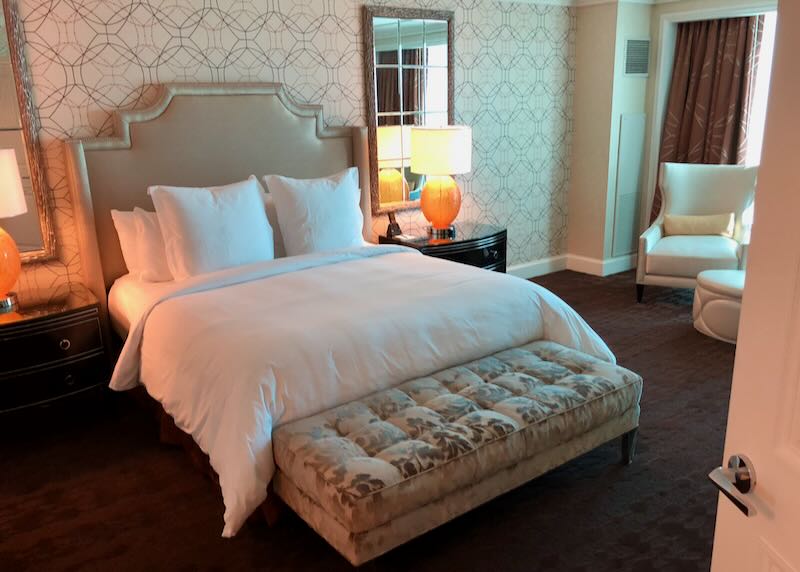
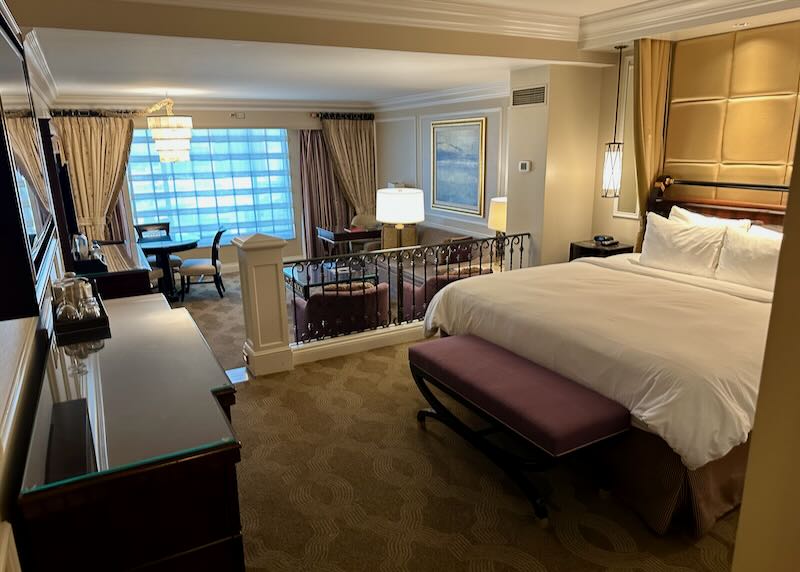
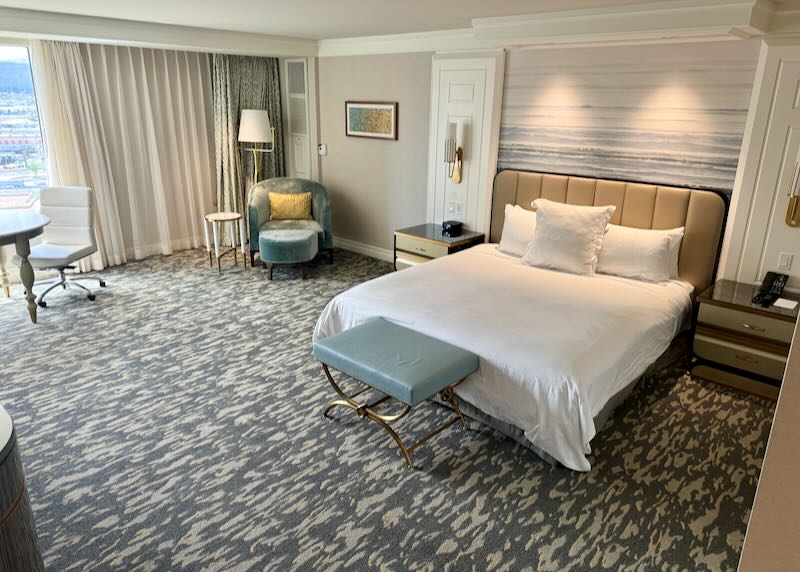
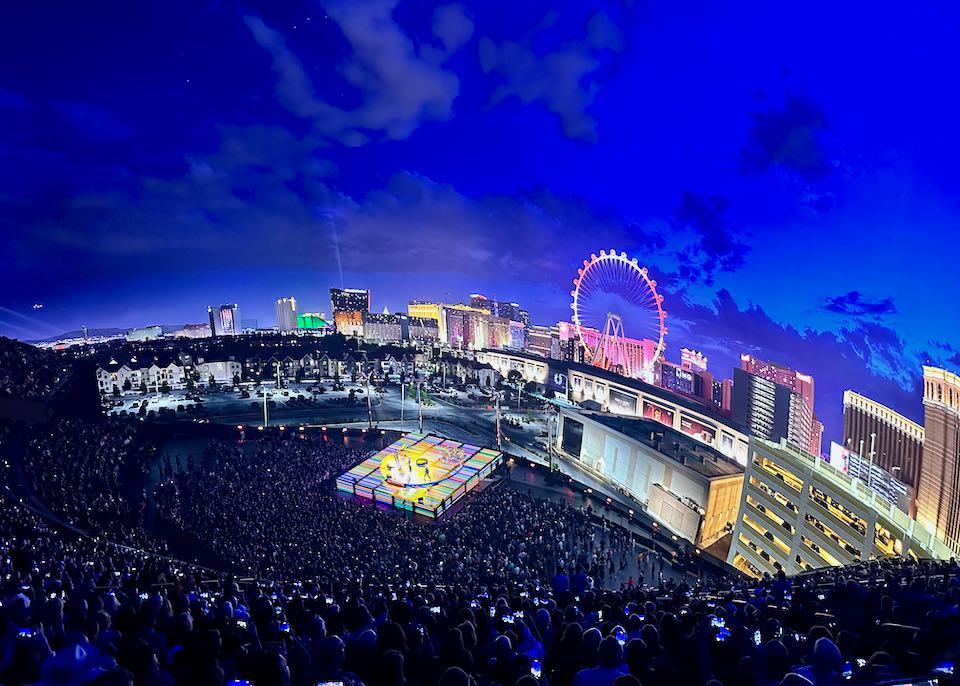
U2 at the Sphere in late October. (Highly recommended!) Both the Venetian and Palazzo are an easy walk to the Sphere along an indoor pedestrian bridge.
Best Area for a Local / Artsy Vibe (Arts District)
Located just south of Downtown, the Arts District (also called “18b” for its original 18-block size) is the city’s cultural heart. It feels like a genuine neighborhood of repurposed warehouses rather than a corporate master plan, filled with vintage stores, galleries, and coffee shops. This is the place to visit standout spots like Able Baker for craft beer or Velveteen Rabbit for serious cocktails without a gaming machine in sight. It is far calmer and more “local” than the frenetic energy of Fremont East, shining best in the late afternoon and early evening. Note: Hotel options here are very limited, with the exception of the boutique The English Hotel. Consequently, most visitors base themselves Downtown for better selection and take the 5-minute Uber ride here. This is where you go to experience Las Vegas as locals do – not as a spectacle, but as a neighborhood.
Areas Most Tourists Feel Comfortable Staying
For the vast majority of visitors, the “comfort zone” centers on two main areas: The Strip and the Fremont Street Experience. The Strip generally feels secure due to the sheer volume of people, bright lights, and heavy surveillance – provided you stay on Las Vegas Boulevard itself and the designated pedestrian bridges. In Downtown, comfort is determined block-by-block. The covered canopy area and the immediate Fremont East core feel bustling and welcoming, but the area becomes significantly quieter and less tourist-oriented once you step outside this zone. Suburban areas like Summerlin and Henderson are statistically the safest parts of the valley, but they are residential, require a rental car, and lack nightlife. Consequently, most visitors are best served staying within the major tourist corridors where lighting, foot traffic, and hotel density are highest.
Areas Tourists Usually Avoid Booking Hotels
For most first-time or short-stay visitors, the trade-off for cheaper rates in these pockets is rarely worth the significant loss of convenience and walkability. North of The STRAT: The area immediately beyond the resort zone (distinct from the separate city of North Las Vegas) is largely industrial and disconnected from the tourist grid. It suffers from poor lighting and offers zero walkability to major sights. Better Alternative: Stay Downtown for better value and energy. East of the Strip: (Specifically the blocks near Twain Avenue and Swenson Street). Tourists book here for the low-priced motels, but the reality is a stark contrast to the Strip. The area lacks resort density, consistent sidewalks, and the “safety in numbers” foot traffic found on the Boulevard. Better Alternative: Look for deals at The LINQ or Flamingo to stay central. The Industrial Corridor: (West of the Strip along Dean Martin Drive). While visitors flock here for the dispensaries, the area is practically uncomfortable for staying. It is designed for vehicle traffic, meaning dark streets and missing sidewalks that make walking back to your hotel at night difficult. Better Alternative: Stay at a proper resort and take a quick Uber for errands. Rule of Thumb: Avoid booking in areas without wide sidewalks, bright lighting, and visible foot traffic if you plan to explore on foot.
The 10 Best Areas in Las Vegas for Tourists
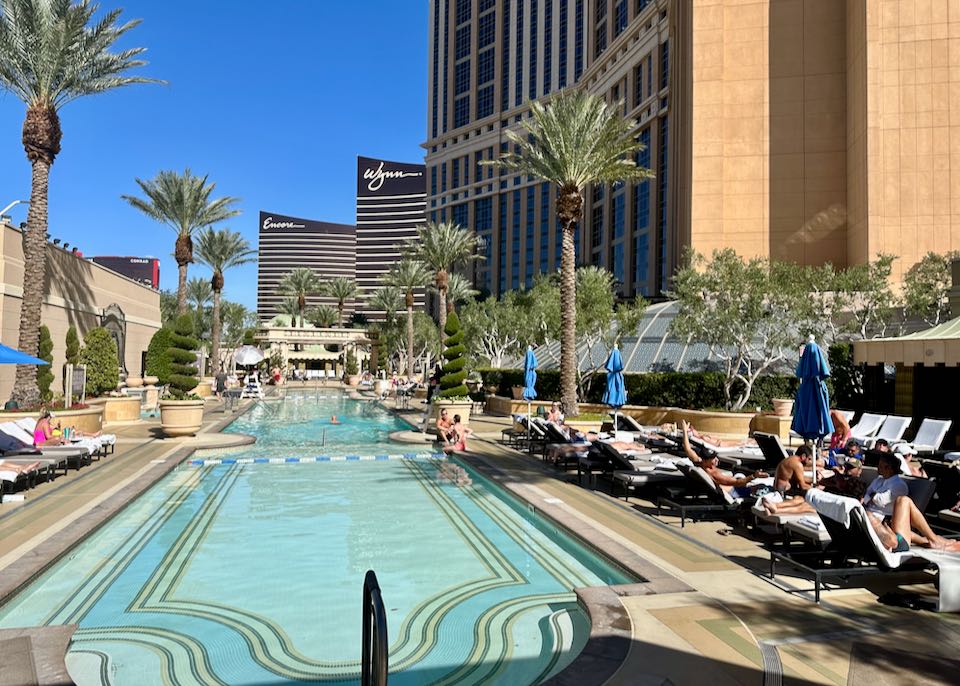
One of many shared pools at the Venetian and Palazzo on the north end of the Strip. The Conrad, Encore, and Wynn are visible in the distance.
1. The Strip
The Strip is the undisputed center of the Las Vegas experience. Although the boulevard is long, the most practical zone for visitors runs roughly north-to-south between Wynn and Park MGM. Staying in this walkable core means more dining, shows, and attractions are within a short walk. Be aware of the trade-off: everything here is expensive, and distances are deceptive – it can take 10–15 minutes just to cross a pedestrian bridge or walk through a single resort. The skyline is in transition; the Tropicana demolition and Hard Rock conversion create gaps that isolate the South Strip (Mandalay Bay/Luxor end), resulting in long stretches of empty sidewalk and a reliance on Uber.
Dining is a major daily focus, defined by excellent, expensive, and reservation-dependent spots from famous chefs. Entertainment is the second major draw, anchored by nighttime spectacles like the massive LED Sphere near The Venetian and A-list residencies at major resort theaters. Luxury shopping centers – like The Forum Shops and Crystals – are major attractions, but if your priority is value or calm, you may be better served Downtown or off-Strip. For first-timers and short stays aimed at seeing the most action, however, this is the best base.
- Best Hotels: Four Seasons • Wynn • Aria • Mandalay Bay • Bellagio • Waldorf Astoria • Palazzo at the Venetian • The Venetian
- Best Cheap/Midrange Hotels: Park MGM • The LINQ
2. North Strip
The North Strip (roughly from Wynn north to The STRAT) is the northern end of the resort corridor, distinct from the separate city of North Las Vegas. It has evolved into a zone of “luxury islands” with few pedestrian connections between resorts. The arrival of Fontainebleau Las Vegas and Resorts World has added impressive anchors, but they are separated by long gaps of empty sidewalk that feel quiet with little street activity at night. Consequently, you should plan on Ubering most places rather than walking.
This area is the best base for business travelers, offering a short 5–10 minute Uber ride to the Convention Center for major trade shows like CES. The vibe here merges new glitz with old-school grit. You are minutes from classic Vegas icons like the Peppermill, Golden Steer Steakhouse, and Dino’s Lounge. The STRAT dominates the far north, offering the best high-altitude views in the city, but be aware that it requires a rideshare to reach the Center Strip. The North Strip works best for newer resorts and conventions – not for walkable sightseeing.
- Best Hotels: Fontainebleau Las Vegas • Sahara • Hilton Grand Vacations
- Best Cheap/Midrange Hotels: The Strat • Thunderbird • Circus Circus
3. Downtown
Downtown is the historic heart of the city, defined by the Fremont Street Experience and the blocks immediately surrounding it. It offers a walkable, high-energy alternative to the Strip with significantly better value. Expect lower table minimums, cheaper dining, and more affordable rooms. The action centers on the pedestrian mall, famous for its overhead LED canopy and the SlotZilla zipline. Be aware that this area is incredibly loud at night due to live bands and canopy shows. For a quiet room, stay a block away at Downtown Grand, which is set back from the concerts and offers much easier rideshare access. The game-changer here is Circa Resort, a massive, adults-only (21+) property famous for its sports book and Stadium Swim pool complex.
For a less touristy vibe, walk east to Fremont East, a district of local bars and speakeasies that really comes alive after 9 pm. A short Uber ride away, the Arts District has evolved into the city’s brewery row and creative dining hub. Downtown’s top daytime attractions are also here: the Neon Museum displays retired Vegas signage (night tours sell out), and the Mob Museum offers a deep dive into organized crime history. Choose Downtown for value, nightlife, and walkability – not for quiet or Strip-style luxury.
- Best Hotels: Circa • Golden Nugget • Downtown Grand
- Best Cheap/Midrange Hotels: The D • Oasis at Gold Spike
4. Summerlin
Summerlin is the “civilized” side of Las Vegas – a quieter, cleaner, master-planned community on the valley’s western edge. It is the ideal base for travelers who want resort-style luxury and golf without the grit and noise of the tourist corridor. Conversely, it is not the right place if your priority is nightlife, shows, or easy casino-hopping. The massive draw here is the outdoors; you are just a 10-minute drive from the scenic loop at Red Rock Canyon and world-class hiking. The social hub is Downtown Summerlin, a walkable outdoor district featuring excellent restaurants and major sports venues like City National Arena (where the Golden Knights practice) and the Las Vegas Ballpark.
The lifestyle here focuses on sunny mornings and alfresco dining rather than late nights. A rental car is essential because the area is spread out. The Strip is a straight shot down Summerlin Parkway, but expect the 20-minute drive to double during rush hour. Choose Summerlin for an active, outdoor-focused trip – not for the typical Vegas spectacle.
- Best Hotel: JW Marriott
- Best Cheap/Midrange Hotel: La Quinta Inn
5. Henderson & Lake Las Vegas
These are two very different experiences located in the southeast valley. Henderson is a polished suburban city perfect for families and travelers seeking massive, resort-style pool decks without the Strip’s chaos. The anchor here is Green Valley Ranch, a luxury resort adjacent to The District – a walkable outdoor hub that makes it easy to grab dinner or ice cream without getting back in the car. Further south, The M Resort offers easy I-15 highway access, making it a favorite first stop for visitors driving in from California. For a local vibe, visit the Water Street District in the evening; this historic core has been revitalized into a walkable pocket of breweries and restaurants.
Lake Las Vegas is not a suburb but a self-contained resort enclave about 20 minutes east of the main Henderson action. Resembling an Italian village built around a private lake, it is primarily for relaxation, golf, and water sports. A rental car is mandatory for either location due to the spread-out layout and lack of transit. Expect a 20-minute drive to the Strip from Henderson, and a 35-minute drive from the Lake. Henderson works best for resort-style family stays; Lake Las Vegas is for unplugged, romantic escapes – not sightseeing.
- Best Hotels: The M Resort • Green Valley Ranch
- Best Cheap/Midrange Hotels: Sunset Station • Westin Lake Las Vegas
6. Boulder City & Lake Mead
Located about 30 minutes southeast of the Strip, Boulder City is a quiet base for families and history buffs, serving as the gateway to the Hoover Dam. Uniquely, it is one of the few cities in Nevada where gambling is illegal (originally to keep dam workers focused), resulting in a small-town atmosphere filled with green parks and Art Deco architecture. The walkable downtown features antique shops and diners alongside the historic Boulder Dam Hotel, which houses a free museum and a basement speakeasy. A major highlight is Hemenway Park, where wild bighorn sheep frequently graze on the grass in the late afternoon.
Outdoor access is excellent, with a short drive connecting you to boating at Lake Mead, ziplines at Bootleg Canyon, and the Nevada State Railroad Museum. If you need gaming, the Hoover Dam Lodge just outside city limits has a small casino. While most visitors come only for a day trip, this is a charming spot for a slow-paced overnight stay, provided you have a rental car. Best for quiet, history, and outdoor access – not nightlife or casino hopping.
- Best Hotel: Best Western
- Best Cheap/Midrange Hotels: Boulder Dam Hotel • Hoover Dam Lodge
7. Chinatown
Las Vegas has one of the best – and most underrated – Chinatowns in North America. Located along Spring Mountain Road just west of the Strip, this corridor is the city’s true culinary engine. Unlike historic districts in other cities, this is an auto-oriented collection of strip malls rather than a walkable neighborhood. You will likely need to Uber between plazas, which are often five minutes apart by car, though parking is almost always free and easy. The dining scene is spectacular, chef-driven, and a favorite of off-duty industry workers. Standout examples include Raku for robata grill, Monta Noodle House for ramen, and Kabuto for Edomae-style sushi.
It is not just Asian food; the area hosts top-tier global spots like Partage (French fine dining) and Sparrow + Wolf (modern American). Nightlife is also excellent here, especially late in the evening. The Golden Tiki is a legendary 24-hour tropical escape, while The Sand Dollar Lounge offers craft cocktails with live blues. This is strictly a dining destination, not a hotel zone, due to a lack of resorts and poor walkability. Chinatown is where you eat like a local, not where you stay – go for dinner, then head back to the Strip.
- Best Nearby Hotels: Wynn • The Venetian • Palazzo at the Venetian
- Best Nearby Cheap/Midrange Hotels: Treasure Island • Gold Coast
8. Red Rock Canyon, Blue Diamond, & Mt. Charleston
The far west valley is the top destination for travelers prioritizing hiking and scenery over nightlife, located about 20–30 minutes from the Strip. The primary draw is Red Rock Canyon, where a 13-mile scenic drive offers access to world-class hiking and climbing. Tip: Timed entry reservations are required for the scenic drive from October 1 to May 31; turnaways are common, especially on weekends, so book online at Recreation.gov before you drive out.
Nearby Blue Diamond is an old mining village that serves as a charming lunch stop, notably for pizza at Cottonwood Station. For a total change of pace, drive about an hour north to Mt. Charleston. It is 20–30 degrees cooler than the valley, offering snowy ski slopes in winter (when tire chains are often required) and cool hiking in summer. A rental car is essential for visiting all three areas, as public transit is non-existent. This area works best as a day trip or quiet nature base – not a substitute for staying in Las Vegas proper.
- Best Hotels: Red Rock Resort (closest luxury resort) • The Retreat on Charleston Peak • The Cabins at Mt. Charleston Lodge
- Best Cheap/Midrange Hotel: The Retreat on Charleston Peak
9. Near UNLV, Airport & Boulder Highway
This area – covering the university district and the “Boulder Strip” along Boulder Highway – is best suited for travelers prioritizing airport access, UNLV events, or budget gaming. The zone closest to the Strip is anchored by the university and Virgin Hotels, which offers a stylish resort vibe with easier parking and better pricing than the main boulevard. Key nearby attractions include the Thomas & Mack Center (for sports and rodeo) and the National Atomic Testing Museum, a fascinating Smithsonian affiliate.
Further east, the Boulder Highway corridor is a haven for “locals” casinos that offer lower minimums and cheaper dining. A car is essential here to reach spots like Boulder Station or Sam’s Town, which is famous for its free, family-friendly “Mystic Falls” laser show in the indoor atrium. The primary advantage of this area is logistics: you are just a 5–10 minute drive from the airport terminals. Choose this location for value, events, and airport convenience – not for sightseeing or walkability.
- Best Hotel: Virgin Hotels
- Best Cheap/Midrange Hotels: Boulder Station • Sam’s Town
10. Jean, Goodsprings, & Primm
These outposts along I-15 South serve as brief roadside stops for drivers coming from California, rather than lodging bases. Primm (at the state line) has faded significantly; with its attractions largely closed and services limited, it is now useful strictly for gas or charging. The real interest begins 12 miles north in Jean, which offers a much better convenient break. The highlight here is Seven Magic Mountains, a massive outdoor art installation best viewed at early morning or sunset. Across the highway, Terrible’s Road House is a reliable stop for clean restrooms and a photo op with a 13-foot Bigfoot statue.
For a true historic gem, take the 10-minute detour west to Goodsprings. This ghost town is home to the Pioneer Saloon (1913), the oldest bar in Southern Nevada. It is famous for its connection to Clark Gable and the video game Fallout: New Vegas – though its Old West atmosphere and “Ghost Burgers” are worth the trip even if you have never played. Treat these locations as memorable pause points on your drive in, not places to base a Vegas stay.
- Best Hotel: There are no recommended hotels in this area. Continue 20 minutes north to The M Resort or South Point.
Map of Las Vegas Area
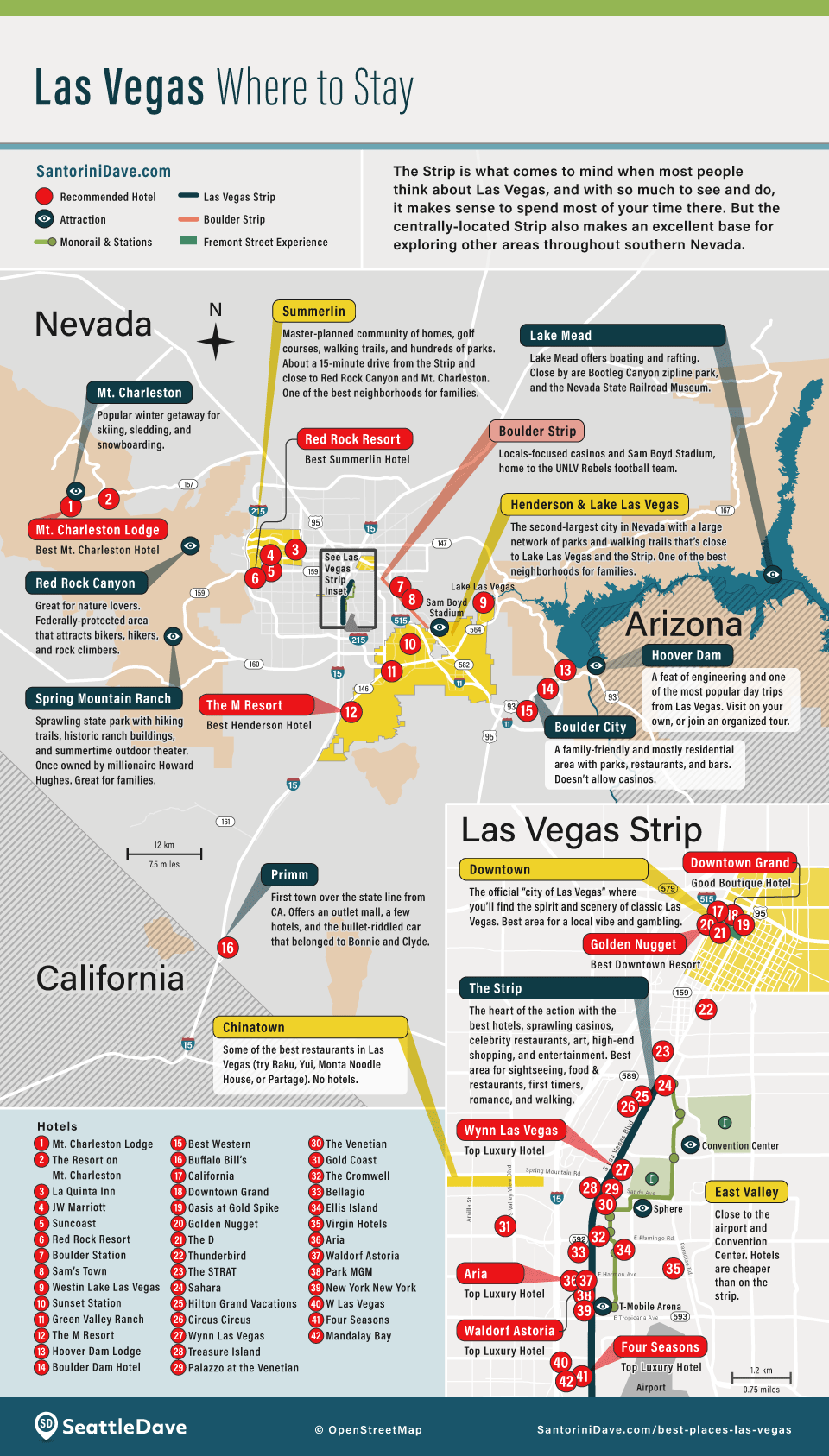
Hotels on Map: 1. Mt. Charleston Lodge • 2. The Resort on Mt. Charleston • 3. La Quinta Inn • 4. JW Marriott • 5. Suncoast • 6. Red Rock Resort • 7. Boulder Station • 8. Sam’s Town • 9. Westin Lake Las Vegas • 10. Sunset Station • 11. Green Valley Ranch • 12. The M Resort • 13. Hoover Dam Lodge • 14. Boulder Dam Hotel • 15. Best Western • 16. Buffalo Bill’s • 17. California • 18. Downtown Grand • 19. Oasis at Gold Spike • 20. Golden Nugget • 21. The D • 22. Thunderbird • 23. The STRAT • 24. SAHARA Las Vegas • 25. Hilton Grand Vacations • 26. Circus Circus • 27. Wynn • 28. Treasure Island • 29. Palazzo • 30. Venetian • 31. Gold Coast • 32. The Cromwell • 33. Bellagio • 34. Ellis Island • 35. Virgin Hotels • 36. Aria • 37. Waldorf Astoria • 38. Park MGM • 39. New York New York • 40. W Las Vegas • 41. Four Seasons • 42. Mandalay Bay