Updated: July 8, 2026 • by Seattle Dave
Seattle is one of the easiest big U.S. cities to visit without a car, but only if you stay in the right area. For most first-time visitors, I would not rent a car for central Seattle. It costs too much, sits in a garage, and becomes one more thing to manage. I live here, and I rarely use my car for trips anywhere near the central neighborhoods.
My blunt advice: stay central, skip the car, use taxis or rideshares when transit gets awkward, and rent a car only for the days you actually leave the city.
The tradeoff is that Seattle is not flat, not perfectly gridded, and not equally convenient in every direction. Walking, Link Light Rail, the Monorail, streetcars, buses, ferries, taxis, and rideshares work very well for the main visitor areas. But a car still makes sense for mountain day trips, outer neighborhoods, suburban visits, and longer Pacific Northwest trips.
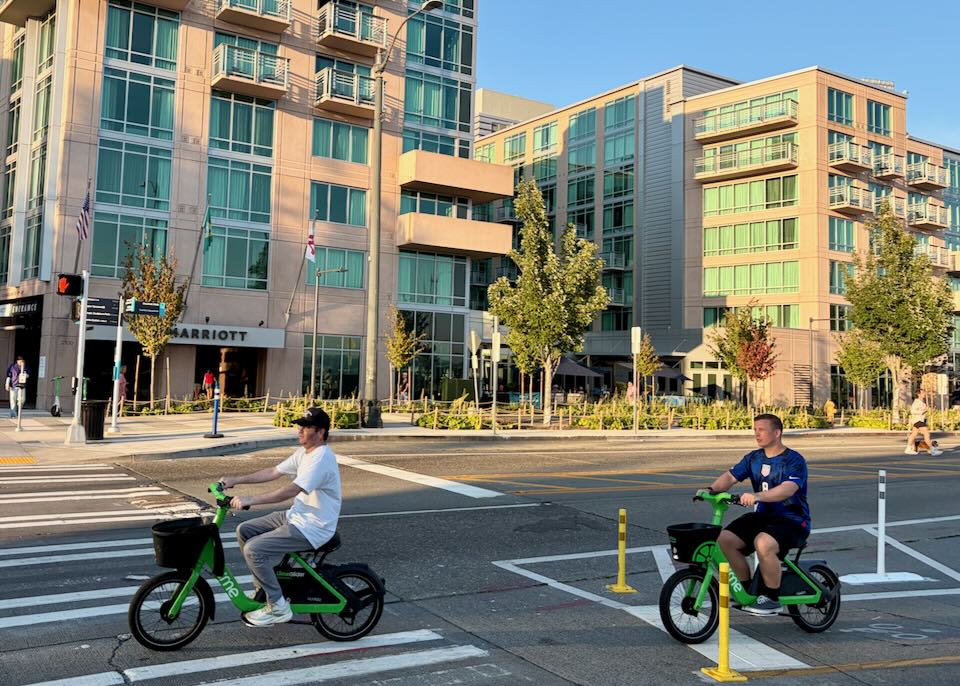
Electric bikes and scooters along the Seattle Waterfront, with the Marriott Waterfront in the background. You can see a lot of central Seattle without a car, though I’d still use taxis or rideshares when hills, luggage, or rain make the short trips annoying.
Do You Need a Car in Seattle?
No, not for a typical first Seattle trip. If your plans are Pike Place Market, the Waterfront, Seattle Center, Space Needle, Chihuly Garden and Glass, MOHAI, Capitol Hill, Pioneer Square, the stadiums, ferries, Ballard for dinner, Fremont for a wander, and maybe a Bainbridge Island day trip, you do not need a car.
A car is more annoying than helpful in central Seattle. Hotel parking is expensive, garages can be tight, street parking is limited, and leaving bags or luggage in a parked car is a bad idea. Downtown traffic is manageable but rarely pleasant. The hills around the Waterfront, Pike Place Market, Capitol Hill, Queen Anne, and First Hill also make “we’ll just park nearby and walk” less simple than it sounds.
You probably do not need a car if:
- You are staying near Pike Place Market, the Waterfront, Belltown, Downtown, Seattle Center, South Lake Union, or Capitol Hill.
- You are visiting for 2 to 4 days and focusing on central Seattle sights.
- You are arriving at Seattle-Tacoma International Airport and staying downtown or near light rail.
- You are taking an Alaska cruise from Pier 66 or Pier 91.
- You are comfortable using taxis or rideshares for hills, luggage, late nights, and awkward transit routes.
- You want to walk onto a ferry to Bainbridge Island, Bremerton, West Seattle, or Vashon.
You might want a car if:
- You are visiting Mount Rainier, Olympic National Park, North Cascades, Snoqualmie Falls, Woodinville wineries, or several far-flung places in one day.
- You are staying outside central Seattle in a residential or suburban area.
- You have mobility issues and want to avoid hills, transfers, and longer walks.
- You are traveling with small kids, strollers, car seats, and a packed schedule.
- You are visiting friends or family in the suburbs.
- You are combining Seattle with Vancouver, Portland, the San Juan Islands, or a longer Pacific Northwest road trip.
The Best Strategy for Most Visitors
Do Seattle without a car, then rent one only for the day or two you leave the city.
That is the sweet spot. Stay in a central hotel, use light rail from the airport if your hotel location makes sense, walk to Pike Place and the Waterfront, use the Monorail for Seattle Center, take ferries as walk-on passengers, and call a rideshare when the route is uphill, rainy, late, or logistically annoying.
This gives you the best of both worlds: no parking stress in the city, but flexibility when you want to get outside it.
For a broader overview of hotel areas, start with my guide to where to stay in Seattle. For specific hotel picks, see my list of the best hotels in Seattle.
Best Areas to Stay in Seattle Without a Car
Hotel location matters more in Seattle than many visitors expect. Two hotels can be six blocks apart and feel very different for walking, hills, restaurants, safety, light rail, airport access, cruise transfers, and nighttime comfort.
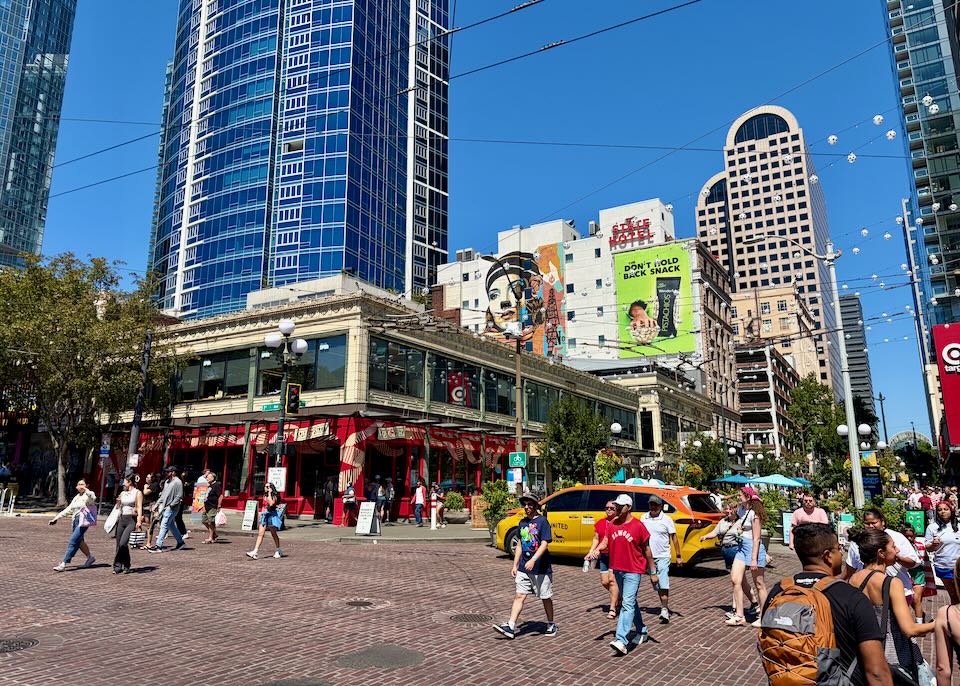
The blocks around Pike Place Market are busy, walkable, and central, which is exactly why I like this area for a car-free Seattle stay. A rental car is more hassle than help here.
For a car-free Seattle trip, I would focus on these areas first:
- Pike Place Market/Market District: best overall for first-time visitors.
- South Belltown: best balance of restaurants, nightlife, Pike Place, Seattle Center, and Pier 66 cruise access.
- Waterfront: best for views, ferries, cruise add-ons, and relaxed sightseeing, but watch the hill.
- Downtown near Westlake or Symphony Station: best for light rail, airport access, shopping, business, and practical logistics.
- Seattle Center/Lower Queen Anne: best for families, Space Needle, Climate Pledge Arena, and a calmer base.
- Capitol Hill: best for restaurants, bars, coffee, nightlife, and a real neighborhood feel.
- South Lake Union: best for business travelers, longer stays, lake walks, MOHAI, and modern hotels.
Pike Place Market: Best Overall Without a Car
Pike Place Market is my favorite base for most first-time visitors without a car. You can walk to the market, restaurants, the Waterfront, Seattle Art Museum, Westlake light rail station, the Monorail, ferries, Belltown, and much of Downtown. It is the most “Seattle” location for a short stay and the easiest place to orient yourself. The big advantage is location. The big downside is that the area is busy, touristy in places, and hilly on the west side toward the Waterfront.
Best for: first-timers, couples, food-focused trips, short stays, ferry day trips, and anyone who wants to walk out the door into classic Seattle.
Watch out for: crowds around the market, the uphill walk from the Waterfront, and expensive hotel parking if you bring a car.
• See my guide to Pike Place Market hotels.
Belltown: Best Balance of Restaurants, Nightlife, and Location
Belltown is one of Seattle’s best car-free neighborhoods if you choose the right blocks. I especially like the southern end of Belltown, closer to Pike Place Market and the Waterfront. From here you can walk to Pike Place, Seattle Center, the Monorail, Pier 66, restaurants, bars, coffee, and the central Waterfront. Belltown has more nightlife and a more urban feel than the Waterfront or Seattle Center. That can be great or annoying depending on your trip. It is convenient and very walkable, but I would pay close attention to exact hotel location here.
Best for: couples, restaurant-focused trips, nightlife, Pier 66 cruise passengers, and visitors who want to walk both to Pike Place and Seattle Center.
Watch out for: noise, nightlife blocks, and the usual downtown edge that can change block by block.
• See my guide to Belltown hotels.
Waterfront: Best for Views, Ferries, and Cruise Add-ons
The Waterfront is an excellent car-free base if you want views, ferries, aquarium access, waterfront walks, and a relaxed feel near the water. It is especially good if you are taking a ferry from Pier 52 Colman Dock, doing a Bainbridge Island day trip, or staying before or after a cruise. The important thing to understand is the hill. Downtown and Pike Place Market sit above the Waterfront. It is not a mountain, but with luggage, kids, bad knees, or rain, that climb matters. Some routes have elevators or gentler grades, but do not assume every walk from the Waterfront to Downtown is easy.
Best for: ferry trips, views, cruise passengers, couples, families who like waterfront walks, and travelers who want a slightly slower base.
Watch out for: the uphill walk to Pike Place and Downtown, some touristy restaurants, and weaker light rail access than hotels closer to Westlake, Symphony, or Pioneer Square stations.
• See my guide to Seattle Waterfront hotels.
Downtown: Best for Light Rail and Practical Logistics
Downtown Seattle is practical without a car, especially near Westlake, Symphony, Pioneer Square, or International District/Chinatown light rail stations. It is good for airport access, business trips, shopping, conventions, quick stays, and visitors who want to move around the city efficiently. But Downtown Seattle is not one uniform neighborhood. Some blocks feel polished and easy. Others feel empty at night or rough around the edges. I like Downtown most when the hotel has a strong, exact location: close to Pike Place, Westlake, the convention center, the waterfront-adjacent core, or a specific office or event.
Best for: airport light rail access, business travelers, convention visitors, shopping, short stays, and travelers who will use transit often.
Watch out for: block-by-block variation, less charm than Pike Place or Capitol Hill, and a quieter feel after office hours in some areas.
• See my guide to Downtown Seattle hotels.
Seattle Center/Lower Queen Anne: Best for Families and Arena Events
Seattle Center and Lower Queen Anne are excellent without a car for families, Space Needle visits, Museum of Pop Culture, Chihuly Garden and Glass, Pacific Science Center, Seattle Children’s Museum, and Climate Pledge Arena events. The Monorail makes it easy to connect to Westlake, Downtown, light rail, and Pike Place Market. This area is calmer than Belltown and more straightforward with kids. Restaurants are easy, sidewalks are manageable, and you do not feel like you are staying in the densest part of Downtown.
Best for: families, Space Needle trips, Kraken games, concerts, arena events, and travelers who want a calmer base.
Watch out for: no direct light rail station, some uphill walking toward Queen Anne, and needing the Monorail or a rideshare to reach Pike Place quickly.
• See my guide to Seattle Center hotels.
Capitol Hill: Best Neighborhood Feel Without a Car
Capitol Hill is a great car-free neighborhood if you want restaurants, bars, coffee, music, parks, bookstores, and nightlife. The Capitol Hill light rail station is useful, and the neighborhood has some of the best food and drink density in Seattle. It is not the most obvious base for a first Seattle trip because it is not right next to Pike Place or the Waterfront. But for repeat visitors, younger travelers, solo travelers, LGBTQ+ travelers, and anyone who prefers neighborhood energy over sightseeing convenience, it can be excellent.
Best for: restaurants, bars, nightlife, solo travelers, repeat visitors, and travelers who want to stay somewhere that feels more local.
Watch out for: hills, nightlife noise, fewer classic hotels, and needing light rail, bus, taxi, or rideshare for Pike Place and the Waterfront.
• See my guide to Capitol Hill hotels.
South Lake Union: Best for Business, Longer Stays, and Lake Walks
South Lake Union is not my first choice for a classic first-time sightseeing stay, but it can work very well without a car. It has modern hotels, lots of business travel infrastructure, MOHAI, the Center for Wooden Boats, lakefront paths, easy rideshares, and decent access to Downtown, Seattle Center, and Capitol Hill. The neighborhood is cleaner and newer-feeling than many parts of Downtown, but less atmospheric. It can feel quiet in the evenings compared with Pike Place, Belltown, or Capitol Hill.
Best for: business travelers, Amazon visits, longer stays, families who want newer hotels, and visitors focused on South Lake Union or Seattle Center.
Watch out for: less classic Seattle atmosphere, no light rail station in the middle of the neighborhood, and a more office-heavy feel.
• See my guide to South Lake Union hotels.
Seattle Areas I Like Less Without a Car
Some Seattle neighborhoods are wonderful, but not ideal as a first-time car-free base.
I would be cautious about staying car-free in:
- Ballard: great restaurants, breweries, locks, shops, and Sunday farmers market, but no light rail and not central. I live in Ballard and love it, but I would not tell most first-time visitors to base here without a car unless they specifically want Ballard.
- Fremont: fun and walkable locally, but getting to the main sights takes more planning. Good for a second or third trip, less ideal for a classic first visit.
- West Seattle: Alki is beautiful and the water taxi is great, but it can feel detached from the main visitor core.
- University District: useful for UW visits and good light rail access, but not my favorite base for general Seattle sightseeing.
- Airport hotels: fine for a late arrival or early flight, not a good base for seeing Seattle.
- Suburban hotels: cheaper on paper, worse in practice once you add transit time, rideshares, parking, and daily logistics.
Seattle Without a Car: Quick Neighborhood Comparison
- Pike Place Market: excellent without a car and the best overall area for most first-time visitors. Great for food, short stays, ferries, the Waterfront, and classic Seattle sightseeing. The tradeoff is crowds and the uphill walk back from the Waterfront.
- Belltown: excellent without a car if you want restaurants, nightlife, Pike Place, Seattle Center, and Pier 66 all within easy reach. The tradeoff is noise and a more urban, block-by-block feel.
- Waterfront: very good without a car for views, ferries, cruise stays, the aquarium, and relaxed walks along Elliott Bay. The tradeoff is the hill up to Pike Place Market and Downtown.
- Downtown: very good without a car if you care about light rail, airport access, shopping, business, conventions, and practical logistics. The tradeoff is less charm than Pike Place, Belltown, or Capitol Hill, plus some uneven blocks.
- Seattle Center/Lower Queen Anne: very good without a car for families, Space Needle visits, museums, Climate Pledge Arena events, and a calmer base. The tradeoff is that it is not directly on light rail, so you will use the Monorail, buses, taxis, or rideshares.
- Capitol Hill: very good without a car for restaurants, bars, coffee, nightlife, bookstores, music, and neighborhood energy. The tradeoff is that it is not as convenient for Pike Place, the Waterfront, or Seattle Center.
- South Lake Union: good without a car for business travelers, longer stays, MOHAI, lake walks, and modern hotels. The tradeoff is that it feels more office-heavy and less atmospheric than Seattle’s best visitor neighborhoods.
- Ballard: fair without a car. Great for restaurants, breweries, shops, the locks, and the Sunday farmers market, but it has no light rail and is not central. Visit by bus or rideshare, but I would not stay here on a first car-free Seattle trip.
- Fremont: fair without a car. Fun for neighborhood wandering, breweries, restaurants, shops, and the Fremont Troll, but you will rely on buses or rideshares more than you would in Pike Place, Belltown, Downtown, or Capitol Hill.
- Airport area: poor for sightseeing without a car. Fine for a late arrival or early flight, but too far from central Seattle to work well as a base for a real visit.
Getting Around Seattle Without a Car
Seattle’s transit system is useful, but it works best when you understand what each mode is good for. Light rail is great for the airport, Capitol Hill, stadiums, the University District, and north-south trips. The Monorail is great for Seattle Center. Ferries are great for day trips. Buses fill in the gaps. Taxis and rideshares are best for luggage, hills, late nights, rainy evenings, and places where transit requires an annoying transfer.
Walking
Walking is the best way to experience central Seattle, but the hills are real. Pike Place to the Waterfront is downhill. The return is uphill. Capitol Hill is uphill from Downtown. Queen Anne is uphill from Seattle Center. Some walks look short on a map but feel much longer with luggage, kids, rain, or tired legs.
Best walks without a car:
- Pike Place Market to the Waterfront.
- Pike Place Market to Belltown.
- Belltown to Seattle Center.
- Waterfront to Pioneer Square.
- Westlake to Pike Place Market.
- Capitol Hill light rail station to Volunteer Park.
- Lake Union waterfront paths near South Lake Union.
- Ferry terminal to Pike Place Market, if you are comfortable with the climb.
Walking tip: If you are traveling with luggage, kids, bad knees, or anyone with mobility limits, do not choose a hotel just because “it is only a 12-minute walk.” In Seattle, elevation matters as much as distance.
Link Light Rail
Link Light Rail is the backbone of car-free Seattle transit. It connects Seattle-Tacoma International Airport with central Seattle and continues north through Capitol Hill, the University District, Roosevelt, Northgate, Shoreline, Mountlake Terrace, and Lynnwood. It also serves the stadium areas and connects into the Eastside for trips toward Bellevue and Redmond.
For visitors, the most useful central stations are:
- Westlake: best for Pike Place Market, Downtown shopping, Monorail connection, South Lake Union streetcar, and many central hotels.
- Symphony: formerly University Street, useful for Seattle Art Museum, central Downtown, and some Waterfront hotels.
- Pioneer Square: useful for Pioneer Square, stadiums, ferries with a bit of walking, and the south end of Downtown.
- International District/Chinatown: useful for King Street Station, Amtrak, Chinatown-International District, and stadiums.
- Capitol Hill: best for Capitol Hill restaurants, bars, coffee, nightlife, and Volunteer Park access.
- Stadium: useful for Mariners, Seahawks, Sounders, and event days.
- U District: useful for the University of Washington, Neptune Theatre, restaurants, and cherry blossoms in season.
Light rail is useful, but it does not go everywhere visitors expect. It does not take you directly to Pike Place Market, the Waterfront, Seattle Center, Ballard, Fremont, Queen Anne, Alki, or Pier 91. For those, you will walk, use the Monorail, take a bus, or use a taxi or rideshare.
Seattle Center Monorail
The Monorail is simple, touristy, and genuinely useful. It runs between Westlake Center in Downtown and Seattle Center, where you will find the Space Needle, Chihuly Garden and Glass, Museum of Pop Culture, Pacific Science Center, Seattle Children’s Museum, Climate Pledge Arena, and several family-friendly attractions. It is especially helpful if you are staying near Pike Place, Downtown, or Westlake and visiting Seattle Center. It also works well in reverse if you stay in Lower Queen Anne and want to connect to light rail at Westlake.
Best use: Westlake to Seattle Center, especially with kids, before an arena event, or when it is raining.
Limitation: It is only one line with two stops. Great for what it does, useless for everything else.
Streetcar
Seattle’s streetcar is more useful for specific local trips than broad sightseeing. The South Lake Union streetcar connects Westlake with South Lake Union. The First Hill streetcar connects Pioneer Square, Chinatown-International District, First Hill, and Capitol Hill. I would not choose a hotel because of the streetcar alone, but it can be handy if the route lines up with where you are going.
Best use: short hops between Downtown, South Lake Union, First Hill, Capitol Hill, and Chinatown-International District.
Limitation: slower and less comprehensive than most visitors expect.
Buses
Seattle buses are better than many visitors assume. They are the best way to reach Ballard, Fremont, Queen Anne, Madison Park, West Seattle, and neighborhoods that light rail misses. That said, buses require a little more comfort with maps and timing. I use them, but for a short visit I would not build the whole trip around buses unless you are already a confident transit user.
Good bus trips for visitors:
- Downtown or Belltown to Ballard.
- Downtown to Fremont.
- Downtown to Queen Anne.
- Downtown to Madison Park.
- Downtown to West Seattle Junction or Alki with some planning.
- Capitol Hill to Madison Valley or the Central District.
Bus tip: If you are choosing between a 35-minute bus trip with a transfer and a 14-minute rideshare, take the rideshare. This is especially true with kids, luggage, rain, or dinner reservations.
Ferries and Water Taxis
Ferries are one of the best parts of visiting Seattle without a car. You do not need a rental car to enjoy them. In fact, walking on is easier, cheaper, and more relaxing. Several excellent ferry options leave from Pier 52 Colman Dock or nearby passenger terminals, walking distance from many Downtown, Waterfront, Pike Place, and Belltown hotels.
Best ferry and water taxi trips without a car:
- Bainbridge Island: the classic easy ferry day trip. Walk on at Colman Dock, ride across the water, then walk into Winslow for shops, restaurants, wine tasting, coffee, and waterfront views.
- Bremerton: a longer ferry ride, more about the ride itself and naval waterfront than a polished tourist town.
- West Seattle Water Taxi: great skyline views and easy access to Alki by shuttle, bus, bike, or rideshare.
- Vashon Island: possible without a car, but more limited once you arrive. Better if you are relaxed about buses or plan a simple walk-and-eat outing.
Ferry tip: For a first-time visitor, Bainbridge Island is the easiest and most rewarding ferry trip without a car.
Taxis and Rideshares
Taxis and rideshares are the tool that makes car-free Seattle easy. Use transit when it is direct. Use a taxi or rideshare when transit is clumsy.
I would use a taxi or rideshare for:
- Late-night returns from Capitol Hill, Ballard, Fremont, or West Seattle.
- Airport transfers with lots of luggage, small kids, or a hotel far from light rail.
- Pier 91 cruise transfers.
- Rainy uphill trips between the Waterfront and Downtown.
- Dinners in Ballard, Fremont, Queen Anne, Madison Park, or West Seattle.
- Travelers with mobility issues who want to avoid hills.
My rule: Do not be too pure about transit. Saving $18 is not worth turning a good evening into a 55-minute, two-transfer slog in the rain.
Airport to Downtown Without a Car
Seattle-Tacoma International Airport is connected to Downtown by Link Light Rail. The ride to central Seattle takes about 38 minutes, and it is the best budget option for solo travelers, light packers, and visitors staying near a light rail station. The airport light rail station is connected to the terminal by a walkway through the parking garage. It is not difficult, but it is not right outside baggage claim. With heavy luggage, tired kids, or mobility issues, that walk can feel longer than expected.
Uber and Lyft pickup is in the airport parking garage. Only Uber Black and Black SUV pick up curbside at baggage-claim level. For a complete step-by-step guide, see Seattle Airport to Downtown.
Best Airport Option by Traveler Type
- Solo traveler on a budget: take Link Light Rail if your hotel is near Westlake, Symphony, Pioneer Square, International District/Chinatown, Capitol Hill, or another station.
- Couple with light luggage: light rail is still a good choice, especially for Downtown, Pike Place, and Capitol Hill hotels.
- Family with kids: taxi or rideshare is worth it, especially after a long flight.
- Travelers with mobility issues: taxi, rideshare, or private transfer is easier.
- Cruise passengers: light rail can work for Downtown pre-cruise hotels, but use taxi or rideshare to the terminal, especially Pier 91.
- Late arrivals: taxi or rideshare is simpler unless you are comfortable using light rail and walking to your hotel at night.
Airport Light Rail Works Best For These Hotel Areas
- Downtown near Westlake: easiest overall.
- Pike Place Market: good if you can handle the walk from Westlake or Symphony with luggage.
- Capitol Hill: very good if your hotel is near the station.
- Pioneer Square: good for south Downtown and stadium-area hotels.
- Seattle Center: possible by light rail to Westlake, then Monorail or taxi.
- Waterfront: possible, but luggage plus hills can make a taxi or rideshare a better choice.
- Belltown: possible from Westlake, but depends on exact hotel location and luggage.
Parking in Seattle: Why I Avoid It
Parking is one of the strongest arguments against renting a car in Seattle. It is expensive, inconvenient, and not always secure. Most central hotels charge for overnight parking, enough that a 3-night stay adds a painful amount to your bill. Some garages have tight ramps. Some require valet. Street parking is limited and confusing for visitors. And leaving anything visible in a parked car is a bad idea.
The parking reality:
- Downtown hotel parking is expensive.
- Waterfront and Pike Place garages fill up during busy periods.
- Event nights near Seattle Center, Lumen Field, and T-Mobile Park can be slow and pricey.
- Street parking rules can be confusing if you are not used to Seattle signs.
- Car break-ins happen, especially when bags, jackets, backpacks, or luggage are visible.
- A rental car sits in a garage while you walk, ferry, or take transit anyway.
If you need a car for Mount Rainier or another day trip, rent it for that day and return it. Do not pay to park it downtown for three extra nights.
Cruise Passengers Without a Car
Most cruise passengers do not need a car in Seattle. In fact, a car creates more hassle than it solves.
Seattle has two main cruise terminals:
- Pier 66 Bell Street Cruise Terminal: in Belltown, walkable from many Belltown, Pike Place, Waterfront, and Downtown hotels if you pack light. With cruise luggage, take a short taxi or rideshare.
- Pier 91 Smith Cove Cruise Terminal: north of Downtown near Magnolia. Do not plan to walk. Take a taxi, rideshare, hotel shuttle, or arranged transfer.
For cruise passengers, I like staying near Pike Place Market, the Waterfront, Belltown, Downtown, or Seattle Center. These areas let you see Seattle before or after the cruise without renting a car. Pier 66 is especially convenient from Belltown and the north end of the Waterfront. Pier 91 is not especially convenient from anywhere on foot, so choose the neighborhood you actually want to stay in and take a ride to the terminal.
See my guide to Seattle cruise hotels.
Best Car-Free Cruise Hotel Areas
- Belltown: best for Pier 66, restaurants, Pike Place, and Seattle Center.
- Pike Place Market: best for one or two sightseeing days before a cruise.
- Waterfront: best for views, ferry access, and easy pre-cruise wandering.
- Downtown: best for airport light rail and practical logistics.
- Seattle Center: best for families who want Space Needle activities before the cruise.
Families Visiting Seattle Without a Car
Seattle works well for families without a car if you choose the right base and do not overpack the day. My favorite car-free family areas are Seattle Center/Lower Queen Anne, Pike Place Market, the Waterfront, and South Lake Union. Seattle Center is the easiest with younger kids because several major attractions are clustered together. Pike Place and the Waterfront are more classic Seattle, but they are also more crowded and hillier.
Best family activities without a car:
- Space Needle, Chihuly Garden and Glass, Museum of Pop Culture, Pacific Science Center, and Seattle Children’s Museum at Seattle Center.
- Seattle Aquarium and Waterfront walks.
- Pike Place Market in the morning before it gets too crowded.
- Monorail between Seattle Center and Downtown.
- Bainbridge Island ferry as a low-effort adventure.
- MOHAI and Lake Union waterfront walks in South Lake Union.
- Mariners, Seahawks, Sounders, or Kraken games depending on the season.
Family tip: Do not underestimate hills with strollers. The Waterfront to Pike Place climb is manageable for many adults but annoying with a stroller, tired kid, diaper bag, and rain jacket. Use elevators, take your time, or call a short rideshare when needed.
Seattle Without a Car for Mobility Issues
Seattle can be rewarding without a car, but it is not the easiest city for travelers with mobility limitations. The biggest issue is not distance. It is elevation. The most important hill for visitors is between the Waterfront and Downtown/Pike Place Market. Capitol Hill is also exactly what it sounds like. Queen Anne rises sharply above Seattle Center. Some sidewalks are uneven, and construction can change familiar walking routes.
Best areas for lower-stress mobility:
- Waterfront: good for flatter waterfront walks, views, ferries, and aquarium access, but plan carefully for uphill trips.
- Seattle Center/Lower Queen Anne: good concentration of attractions with less need to cross Downtown hills.
- Pike Place Market: excellent location, but choose hotel carefully and expect crowds and grade changes.
- Downtown near light rail: practical, but exact block matters.
Mobility advice: Use taxis and rideshares more often than you think you should. Seattle is a city where a $12 ride can save a lot of frustration.
Best Things To Do Without a Car
You can do a lot in Seattle without a car. These are the easiest, most satisfying car-free sights and activities.
- Pike Place Market: best early in the morning, before the biggest crowds arrive.
- Seattle Waterfront: aquarium, piers, views, ferries, and casual walks along Elliott Bay.
- Seattle Center: Space Needle, Chihuly, MoPOP, Pacific Science Center, Monorail, and Climate Pledge Arena.
- Capitol Hill: restaurants, bars, coffee, Elliott Bay Book Company, Volunteer Park, and nightlife.
- South Lake Union: MOHAI, Center for Wooden Boats, lake views, and easy walking paths.
- Pioneer Square: historic architecture, underground tours, galleries, bars, and stadium access.
- Stadiums: Mariners, Seahawks, Sounders, and event days are very doable by light rail.
- Bainbridge Island: one of the best no-car day trips from Seattle.
- West Seattle Water Taxi: great skyline views and a fun warm-weather outing.
- Ballard: locks, restaurants, breweries, and the Sunday farmers market, best by bus or rideshare.
- Fremont: troll, shops, restaurants, breweries, and neighborhood wandering, best by bus or rideshare.
Day Trips from Seattle Without a Car
Some Seattle day trips are excellent without a car. Others are theoretically possible but not worth the hassle. For more ideas, see my guide to short trips from Seattle.
Best No-Car Day Trips
- Bainbridge Island: the best and easiest day trip without a car. Walk-on ferry from Downtown, then walk into Winslow.
- Bremerton: a longer ferry ride with great water views. Better for ferry lovers than shoppers or food-focused travelers.
- West Seattle and Alki: take the water taxi, then shuttle, bus, bike, or rideshare to Alki Beach.
- University of Washington: easy by light rail. Good for cherry blossoms in season, campus walks, museums, and Husky Stadium events.
- Bellevue: increasingly easy by light rail and useful for shopping, business, and Eastside visits.
- Tacoma: possible by transit, though slower. Good for museums if you are comfortable with regional transit.
Day Trips Where I Would Rent a Car or Take a Tour
- Mount Rainier National Park: rent a car or take a tour. Do not try to piece this together with public transit.
- Olympic National Park: rent a car, take a tour, or plan an overnight trip. It is too spread out for a simple transit day trip.
- North Cascades: car required for a useful visit.
- Woodinville wineries: possible by rideshare or tour, but a car is not useful if everyone wants to taste. Book a tour, hire a driver, or use rideshares carefully.
- Snoqualmie Falls: possible with transit and rideshares, but easier with a car or tour.
- Leavenworth: possible by train or bus with planning, but better as an overnight or organized trip than a casual car-free day.
When To Rent a Car in Seattle
Rent a car when you leave the city, not when you arrive. That is the basic strategy.
Good reasons to rent a car:
- You are driving to Mount Rainier, Olympic National Park, North Cascades, or the San Juan Islands.
- You want to combine several outer neighborhoods in one day, such as Ballard, Discovery Park, West Seattle, and Seward Park.
- You are visiting relatives or friends in the suburbs.
- You are doing a Pacific Northwest road trip after Seattle.
- You have mobility needs that make transit and hills difficult.
- You are traveling with kids and a schedule that would otherwise require many rideshares.
Bad reasons to rent a car:
- You think every American city requires one.
- You are staying Downtown and mostly sightseeing.
- You want to visit Pike Place, the Space Needle, the Waterfront, and Capitol Hill.
- You are taking a cruise and only have one night in Seattle.
- You found a cheaper suburban hotel but have not added the time and transportation cost.
- You plan to leave luggage in the car while sightseeing.
Seattle Without a Car Itineraries
One Day Without a Car
- Morning: Pike Place Market before it gets crowded.
- Late morning: walk down to the Waterfront and visit the aquarium or piers.
- Lunch: eat near Pike Place, the Waterfront, or Belltown.
- Afternoon: Monorail from Westlake to Seattle Center for Space Needle, Chihuly, or MoPOP.
- Evening: dinner in Belltown, Capitol Hill, or back near Pike Place.
Two Days Without a Car
- Day 1: Pike Place Market, Waterfront, Seattle Center, and Belltown dinner.
- Day 2: Bainbridge Island ferry in the morning, then Capitol Hill for dinner and drinks.
Three Days Without a Car
- Day 1: Pike Place, Waterfront, Seattle Center, and Monorail.
- Day 2: Bainbridge Island ferry, Pioneer Square, and a stadium-area walk if there is a game.
- Day 3: Capitol Hill, South Lake Union, Ballard, Fremont, or West Seattle depending on your interests.
Four or Five Days Without a Car
With four or five days, I would still stay car-free in the city, then consider renting a car for one day outside Seattle.
- Best car-free add-on: Bainbridge Island ferry.
- Best one-day car rental: Mount Rainier in good weather.
- Best food neighborhood add-on: Ballard or Capitol Hill.
- Best family add-on: Seattle Center plus South Lake Union.
- Best low-effort scenic add-on: West Seattle Water Taxi and Alki.
Seattle Without a Car by Traveler Type
First-Time Visitors
Stay near Pike Place Market, South Belltown, the Waterfront, or Downtown near Westlake. Walk, use the Monorail, take one ferry, and use rideshares when needed. Do not rent a car unless you are leaving the city.
Couples
Pike Place, Belltown, the Waterfront, and Capitol Hill are the best car-free choices. Belltown is great for restaurants and walking both to the market and Seattle Center. Capitol Hill is better if you care more about nightlife and neighborhood energy than classic sightseeing.
Families
Seattle Center/Lower Queen Anne, the Waterfront, Pike Place, and South Lake Union are the easiest. Do fewer things per day than the map suggests. Use the Monorail. Use taxis or rideshares for hills, rain, and tired kids.
Cruise Passengers
Skip the rental car. Stay in Pike Place, Belltown, the Waterfront, Downtown, or Seattle Center. Use a taxi or rideshare to the cruise terminal, especially Pier 91. Pier 66 is closer to Belltown and the Waterfront, but luggage still matters.
Solo Travelers
Light rail is a great tool for solo travelers. I would stay near Pike Place, Downtown, Capitol Hill, or Belltown. Be practical late at night: if the walk feels too quiet or the transit route is clumsy, take a rideshare.
Travelers With Mobility Issues
Choose the hotel carefully. The Waterfront can be pleasant and relatively flat along the water, but getting uphill to Downtown is the issue. Seattle Center can be easier than Pike Place for clustered attractions. Use taxis and rideshares freely.
Business Travelers
Downtown, South Lake Union, and the convention center area work well without a car. Use light rail from the airport if your hotel is convenient to a station. Otherwise, a taxi or rideshare is easier.
Best Practical Tips for Seattle Without a Car
- Stay central. A cheaper hotel far from the sights is not cheaper once you add time, rideshares, and hassle.
- Use light rail for the airport if your hotel is near a station. If not, take a taxi or rideshare.
- Use the Monorail for Seattle Center. It is simple, quick, and useful.
- Walk onto ferries. Bainbridge Island is the easiest ferry day trip.
- Do not leave luggage in a car. Not for five minutes, not in a trunk, not “just while we see the market.”
- Plan around hills. Especially Waterfront to Pike Place, Downtown to Capitol Hill, and Seattle Center to Queen Anne.
- Use taxis and rideshares strategically. They are cheaper than renting and parking a car for the whole trip.
- Check event schedules. Kraken, concerts, Mariners, Seahawks, Sounders, and big conventions can change traffic, parking, hotel rates, and rideshare prices.
- Rent a car outside Downtown if it saves money and stress. For some day trips, an airport or neighborhood rental office can be easier than dealing with a downtown garage.
- Do not over-plan cross-city sightseeing. Seattle rewards focused days more than frantic zigzagging.
FAQ: Seattle Without a Car
Can you visit Seattle without a car?
Yes. Most first-time visitors can easily visit Seattle without a car if they stay in Pike Place Market, the Waterfront, Belltown, Downtown, Seattle Center, South Lake Union, or Capitol Hill. Walking, light rail, Monorail, ferries, buses, taxis, and rideshares cover the main visitor needs.
Is Seattle walkable?
Central Seattle is walkable, but it is hilly. Pike Place, Belltown, Downtown, the Waterfront, Seattle Center, South Lake Union, Pioneer Square, and Capitol Hill are all walkable in pieces. The challenge is connecting them when hills, luggage, rain, kids, or mobility issues are involved.
What is the best area to stay in Seattle without a car?
For most first-time visitors, Pike Place Market is the best area to stay without a car. It has the best mix of sightseeing, restaurants, walking, Waterfront access, transit access, and classic Seattle atmosphere. Belltown, the Waterfront, Downtown near Westlake, Seattle Center, and Capitol Hill can also be excellent depending on your trip.
Is Pike Place Market a good base without a car?
Yes. Pike Place Market is probably the best overall base without a car. You can walk to the Waterfront, Belltown, Downtown, ferries, restaurants, and light rail. The only real downsides are crowds and hills.
Is the Waterfront a good base without a car?
Yes, especially for views, ferries, cruise add-ons, and relaxed sightseeing. The main issue is the hill between the Waterfront and Pike Place or Downtown. If hills are hard for you, budget for short taxis or rideshares.
Is Belltown good without a car?
Yes. Belltown is very convenient without a car, especially the blocks closer to Pike Place Market and Pier 66. It is good for restaurants, nightlife, Seattle Center, and Waterfront access. Exact hotel location matters.
Can I get from Seattle airport to downtown without a car?
Yes. Link Light Rail connects Seattle-Tacoma International Airport with Downtown Seattle, including Westlake, Symphony, Pioneer Square, International District/Chinatown, and Capitol Hill stations. It is the best budget option. Taxis and rideshares are easier with luggage, kids, late arrivals, or hotels far from a station.
Do I need a car for Pike Place Market, Space Needle, and the Waterfront?
No. Those are exactly the kinds of sights where a car is unnecessary. Walk between Pike Place and the Waterfront, then use the Monorail from Westlake to Seattle Center for the Space Needle.
Do I need a car for a Seattle cruise?
No. Most cruise passengers should not rent a car. Stay in Pike Place, Belltown, the Waterfront, Downtown, or Seattle Center, then take a taxi or rideshare to the terminal. Pier 66 is close to Belltown and the Waterfront. Pier 91 requires a ride.
Can I do Bainbridge Island without a car?
Yes. Bainbridge Island is the best car-free day trip from Seattle. Walk onto the ferry at Colman Dock, enjoy the ride, then walk into Winslow for food, shops, wine tasting, coffee, and waterfront views.
Can I visit Mount Rainier without a car?
Not easily. For Mount Rainier, rent a car or take a tour. It is not a good public-transit day trip.
Can I visit Ballard without a car?
Yes, but it is easier by bus or rideshare than by light rail. Ballard is worth visiting for the locks, restaurants, breweries, shops, and Sunday farmers market, but I would not use it as a first-time car-free hotel base.
Can I visit Fremont without a car?
Yes. Fremont is doable by bus or rideshare and is fun for the Fremont Troll, shops, restaurants, breweries, and neighborhood wandering. It is better as an outing than a first-time hotel base.
Is public transit safe in Seattle?
For most visitors, yes, especially during normal daytime and evening hours on common routes. Use the same judgment you would in any big city. Late at night, with luggage, or if a route feels awkward, take a taxi or rideshare.
Should I rent a car for one day in Seattle?
Sometimes. If you want to visit Mount Rainier, Snoqualmie Falls, Woodinville wineries, Olympic National Park, or several outer neighborhoods in one day, a one-day rental can make sense. Do not rent a car for the whole stay unless you truly need it.
Is Seattle good for a car-free family trip?
Yes, if you stay near Seattle Center, Pike Place, the Waterfront, South Lake Union, or Downtown. Seattle Center is the easiest family base because many attractions are clustered together and the Monorail connects quickly to Downtown.
What is the biggest mistake visitors make without a car?
Choosing a hotel that is technically “Seattle” but not convenient for the trip they want. A suburban or airport-area hotel can look cheaper, then cost you time and rideshare money every day. For a short visit, location is worth paying for.
Bottom Line
You do not need a car for Seattle if you choose the right hotel area and keep your plans focused. For most visitors, the best strategy is simple: stay central, walk a lot, use light rail and the Monorail where they work, take ferries as walk-on passengers, and use taxis or rideshares when Seattle’s hills or transit gaps get annoying.
Rent a car only when the trip actually calls for one: Mount Rainier, Olympic National Park, North Cascades, Woodinville, suburban visits, or a longer Pacific Northwest road trip. Otherwise, leave the car out of it. Seattle is easier, cheaper, and more enjoyable without one.